
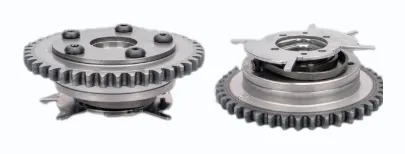
A VVT camshaft adjuster, also called a phaser, sits on the end of the camshaft in place of a plain sprocket. Inside it a rotor with vanes, fixed to the camshaft, turns within a housing fixed to the sprocket; engine oil, directed by a solenoid control valve, pushes the vanes one way or the other, so the camshaft turns a few degrees against its drive and the valves open earlier or later. The engine control unit uses this to give more torque at low speed, more power at high speed and lower emissions and consumption in between. A locking pin holds the adjuster at its base position when there is no oil pressure, so the engine starts quietly and in time.
Adjusters wear inside. The locking pin and its seat wear, so the vanes rattle for a moment after every cold start until oil pressure takes over; the vanes and the housing wear, so the adjuster no longer holds the angle the control unit asks for and the engine idles roughly, loses power and logs a camshaft timing fault. Dirty oil and blocked oil ports make all of this worse, which is why the oil condition and the control valve are checked before the adjuster is condemned.
MONTTRON VVT camshaft adjusters are made to OEM-compliant quality and as aftermarket spare parts: the sprocket, the vane geometry, the oil ports and the locking pin of the original, so the adjuster runs on the original chain and answers the original control valve. The materials are tested for durability and temperature resistance.
The range covers European and Japanese passenger cars. Each reference is identified by the OE number of the original part; send that number and the vehicle identification number (VIN) and we confirm the matching MONTTRON reference.
For availability and OE cross-references, contact us by email.