
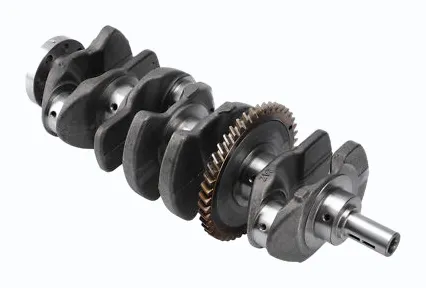
The crankshaft is the backbone of the engine. The connecting rods push on its offset rod journals at every power stroke, and the shaft turns that push into rotation; its main journals run in the bearings of the block, its counterweights balance the reciprocating mass, and drilled passages carry oil from the main bearings to the rod bearings. At one end it drives the timing chain or belt and the auxiliary belt through its sprocket and pulley; at the other the flywheel or the flexplate takes the drive to the gearbox. A toothed ring on the shaft gives the engine control unit the crankshaft position signal.
Crankshafts fail through their bearings. When the oil is low, old or of the wrong grade, or when a pick-up strainer or an oil pump fails, a bearing runs dry, its lining wipes and the journal scores; the bearing can spin in its housing and the shaft overheats, bends or cracks. Detonation, hydro-lock and a timing failure that lets pistons meet valves load the shaft beyond its design. Worn thrust faces let the shaft float; a damaged keyway or sensor ring loses the timing or the position signal.
MONTTRON crankshafts are made to OEM-compliant quality and as aftermarket spare parts: the stroke, the journal diameters, the thrust faces, the sprocket and the flange of the original, balanced as the original, so the shaft runs in the original bearings and drives the original timing and flywheel. The materials are tested for durability and temperature resistance.
The range covers European and Japanese passenger cars. Each reference is identified by the OE number of the original part; send that number and the vehicle identification number (VIN) and we confirm the matching MONTTRON reference.
For availability and OE cross-references, contact us by email.