
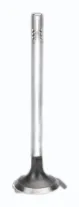
Engine valves open and close the ports between the intake and exhaust passages and the combustion chamber. Each is a poppet valve: a disc-shaped head on a long stem, held closed by a spring and opened by the camshaft through a tappet or follower. When closed, the head seals against a hardened seat in the cylinder head; when open, it lets the charge in or the exhaust gases out. Exhaust valves run much hotter than intake valves and are made of heat-resistant steels, sometimes with a hollow stem filled with sodium to carry heat away.
Valves fail with heat and with timing. An exhaust valve that no longer seats, because of carbon, a worn guide or a weak spring, cannot pass its heat to the seat, burns at the edge of the head and the cylinder loses compression. A valve stem wears in its guide and lets oil into the port. And when the timing chain or belt fails, the pistons strike the open valves and bend them; every valve in the affected cylinders is then checked.
MONTTRON engine valves are made to OEM-compliant quality and as aftermarket spare parts: the head diameter, the stem diameter, the length, the seat angle and the collet grooves of the original, so the valve seats on the original seat, runs in the original guide and takes the original spring and collets. The materials are tested for durability and temperature resistance.
The range covers European and Japanese passenger cars. Each reference is identified by the OE number of the original part; send that number and the vehicle identification number (VIN) and we confirm the matching MONTTRON reference.
For availability and OE cross-references, contact us by email.