
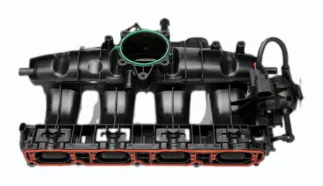
The intake manifold carries the air from the throttle body, or the mixture of air and fuel on older engines, to the intake port of each cylinder. Its runners are shaped so that every cylinder receives the same quantity of air, and their length is chosen for the torque curve of the engine. The manifold also holds the manifold vacuum that the engine control unit measures, carries the pressure and temperature sensors, the brake servo and ventilation connections and, on many engines, runner flaps or swirl flaps that alter the airflow with speed and load. Most modern manifolds are moulded plastic; aluminium is used on older and on some turbocharged engines.
Manifolds fail at their joints and in their moving parts. Plastic flanges warp with heat cycles and the gasket no longer seals, so unmetered air enters and the engine idles roughly, hesitates and logs a lean-mixture fault. Plastic cracks at the throttle body flange or at the mounting bosses. On diesel engines soot and oil from the crankcase ventilation and the exhaust gas recirculation coat the runners and seize the swirl flaps; when a flap or its shaft breaks, the manifold is replaced complete.
MONTTRON intake manifolds are made to OEM-compliant quality and as aftermarket spare parts: the flanges, the runner lengths and the sensor and hose connections of the original, so the manifold takes the original throttle body, sensors and gaskets. The materials are tested for durability and temperature resistance.
The range covers European and Japanese passenger cars. Each reference is identified by the OE number of the original part; send that number and the vehicle identification number (VIN) and we confirm the matching MONTTRON reference.
For availability and OE cross-references, contact us by email.