
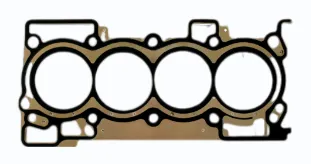
A gasket seals the joint between two faces of the engine. The most demanding is the cylinder head gasket, which sits between the block and the head and has to hold the pressure of combustion in the cylinders while keeping the coolant passages and the oil galleries that cross the joint separate from each other and from the cylinders. Modern engines use multi-layer steel gaskets: several thin steel sheets, embossed and coated, that spring back with every heat cycle. Older designs use composite gaskets of fibre and steel. The valve cover, the oil pan and the intake manifold have gaskets of their own, in rubber, cork-rubber or moulded silicone, that keep oil in and air and dirt out.
A head gasket fails when the joint moves: overheating warps the head or the block, the bolt tension drops, or detonation lifts the head. Combustion gas then pushes into the coolant, coolant seeps into a cylinder or into the oil, and the engine overheats, misfires or loses coolant without a visible leak. The softer gaskets fail with age: the rubber hardens and shrinks, and oil weeps from the valve cover onto the exhaust manifold or from the oil pan onto the floor.
MONTTRON gaskets are engineered for a seal that prevents coolant and oil leaks, in materials that withstand high temperatures and pressure, and made to the outline, the openings and the thickness of the original gasket, so the compression height and the coolant and oil passages match the engine.
The range covers European and Japanese passenger cars. Each reference is identified by the OE number of the original part; send that number and the vehicle identification number (VIN) and we confirm the matching MONTTRON reference.
For availability and OE cross-references, contact us by email.