
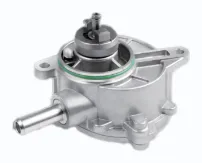
A vacuum pump supplies the vacuum that the brake servo and many actuators need. A petrol engine with a throttle produces vacuum in its intake manifold whenever the throttle is nearly closed; a diesel engine has no throttle, and a direct-injection petrol engine runs with the throttle wide open much of the time, so both need a pump. It is bolted to the cylinder head and driven from the end of the camshaft, and inside it a rotor with sliding vanes, lubricated by engine oil, draws air out of the servo and the vacuum reservoir and pushes it into the crankcase.
Vacuum pumps wear inside and leak outside. The vanes and the rotor wear with the miles, or a vane breaks, and the pump no longer reaches the vacuum the servo needs: the brake pedal grows hard, first after several brake applications and then always, and the turbocharger and exhaust flap actuators move sluggishly. The seals to the head and around the drive shaft wear and oil runs down the engine or is drawn into the vacuum lines and the servo. A noisy pump has a worn coupling or bearing.
MONTTRON vacuum pumps are made to OEM-compliant quality and as aftermarket spare parts: the drive coupling, the mounting flange, the seals and the vacuum outlet of the original, so the pump fits the original head, takes the original drive and feeds the original lines. The materials are tested for durability and temperature resistance.
The range covers European and Japanese passenger cars. Each reference is identified by the OE number of the original part; send that number and the vehicle identification number (VIN) and we confirm the matching MONTTRON reference.
For availability and OE cross-references, contact us by email.