
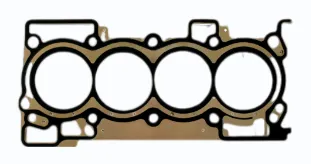
The short answer
The head gasket sits between the cylinder block and the cylinder head and keeps three things apart that cross the joint: the pressure of combustion, the coolant and the oil. It fails when the joint moves, almost always after the engine has overheated. The signs are coolant that disappears without a visible leak, white steam from the exhaust, a milky film in the oil, bubbles in the coolant reservoir with the engine running, and an engine that overheats or misfires when cold. A workshop confirms it with a compression test, a leak-down test or a chemical test of the coolant, and fixes whatever caused the overheating before fitting the new gasket.
What the gasket does
Wikipedia states the job plainly: “a head gasket provides the seal between the engine block and cylinder head(s)”, and its purpose is to “seal the combustion gases within the cylinders and to avoid coolant or engine oil leaking” into places they do not belong. The RAC explains why this one is different from every other gasket in the engine: “it’s the most stressed gasket in the engine because unlike any other, it simultaneously seals oil, coolant and compression from the cylinders.”
The gasket does this with a very thin section. According to Wikipedia, “most modern engines are produced with MLS gaskets. These consist of two to five (typically three) thin layers of steel”, embossed and coated so that they spring back at every heat cycle. The older composite design, of fibre on a steel core, “is more prone to blowouts than newer designs.”
Why it fails
The joint has to stay closed under the clamping force of the head bolts. Anything that lifts the head or distorts the faces opens a path. The RAC puts the most common cause first: “a perforation to your gasket, or a dreaded blown head gasket, usually occurs through overheating.” A hot head expands more than the block and warps; when it cools, the gasket no longer fills the gap. The AA agrees that “the most common cause of head gasket failure is overheating which can cause damage” to the gasket and to the head itself.
The second cause is pressure. The RAC notes that “pre-ignition trouble could see fuel combusted at the wrong time, sending large amounts of pressure into the cylinder head”, and Wikipedia gives the scale of it: with severe detonation “the cylinder pressure can increase to eight times above normal pressures.” A gasket can also fail because it was fitted badly: the AA warns that “you’ll want to make sure that your head gasket is of a high quality and properly installed/sealed”, with the faces clean and flat and the bolts tightened in the specified sequence and to the specified torque or angle.
The signs
| Sign | What is happening |
|---|---|
| White steam from the exhaust, with a sweet smell | Coolant is leaking into a cylinder and burning: “white smoke from the exhaust suggests that coolant is entering the combustion chamber” (Wikipedia) |
| Coolant level falls, no leak on the floor | Coolant goes into the cylinders or the oil instead of onto the ground |
| A milky, mayonnaise-like film on the dipstick or under the oil filler cap | Coolant is mixing with the oil: “a milky white liquid can be seen on the dipstick or around the engine’s oil filler cap” (RAC) |
| Bubbles in the coolant reservoir with the engine running, or the reservoir overflowing | Combustion gas is being pushed into the cooling system |
| The engine overheats, sometimes only in traffic | The cooling system is losing coolant or is full of gas that the pump cannot move |
| Misfire when cold, loss of power | Compression is leaking from one cylinder to the next or into the coolant: “a perforation to the gasket will cause pressure in the combustion chamber to decrease along with your engine power” (RAC) |
Not every sign means the gasket. A leaking radiator cap, a weeping water pump or a failed thermostat produce some of the same symptoms, which is why a workshop tests before it condemns the gasket.
What a workshop checks
Wikipedia lists the three usual tests: “common test methods for head gasket leaks are a compression test, a leak-down test or a chemical test.” The compression test shows a cylinder that holds less pressure than its neighbours; the leak-down test, with compressed air fed into the cylinder, shows where that pressure goes, into the coolant, the sump or the next cylinder; and the chemical test, a dye drawn through the fumes above the coolant, changes colour when combustion gas is present. The AA adds the cooling-system pressure test: “you can try a pressure test of your cooling system, though it’s best to get this done at a garage.”
Once the gasket is confirmed, the head comes off and is measured. A face that is warped beyond the limit is machined or the head is replaced; a cracked head is replaced. The gasket is always new, the head bolts are renewed where the manufacturer specifies stretch bolts, and the cause of the overheating, whether a water pump, a thermostat, a fan or a leaking hose, is repaired first, or the new gasket will fail the same way.
Whether to keep driving
No. The AA’s advice is that “it’s not recommended to drive with a blown head gasket as pressure in the combustion chamber reduces”, and the RAC explains the damage that follows: “if motor oil mixes with coolant it becomes diluted and doesn’t offer the same level of lubrication, this could lead to irreparable damage.” Coolant in a cylinder can also bend a connecting rod when the engine is started. The car is towed or driven the shortest possible distance with the temperature watched.
MONTTRON supplies gaskets, cylinder heads, water pumps and valve covers for European and Japanese passenger cars, identified by OE reference.